Executive Summary
Europe stands at a quiet inflection point. For decades, digital innovation optimised for engagement on screens while the deeper work of sustaining social fabric—how people meet, belong, and build lives together in cities—was treated as an externality. Meanwhile, Europe is formalising a distinct approach to technology and industry: human-centric, trustworthy, sustainable, and resilient. Research and innovation
This publication argues that the next decade of value creation in Europe will come from systems that increase real-world participation and belonging—without collapsing privacy, identity, or autonomy. Loneliness and weak social ties are already measurable at continental scale, with the European Commission's Joint Research Centre reporting both frequent loneliness and low contact frequency as widespread patterns in Europe. EU Science Hub
Deriss proposes a framing to bridge policy ambition and daily life: Europe's Human-Centric Experience Layer—a new infrastructure layer that uses AI not to capture attention, but to strengthen the lived texture of European civilisation by making it easier to access the right places, communities, and shared experiences in the physical world.
1) From Engagement Infrastructure to Social Fabric
The last twenty years were dominated by an implicit project: building a global engagement infrastructure—feeds, recommendation systems, and metrics optimised for attention.
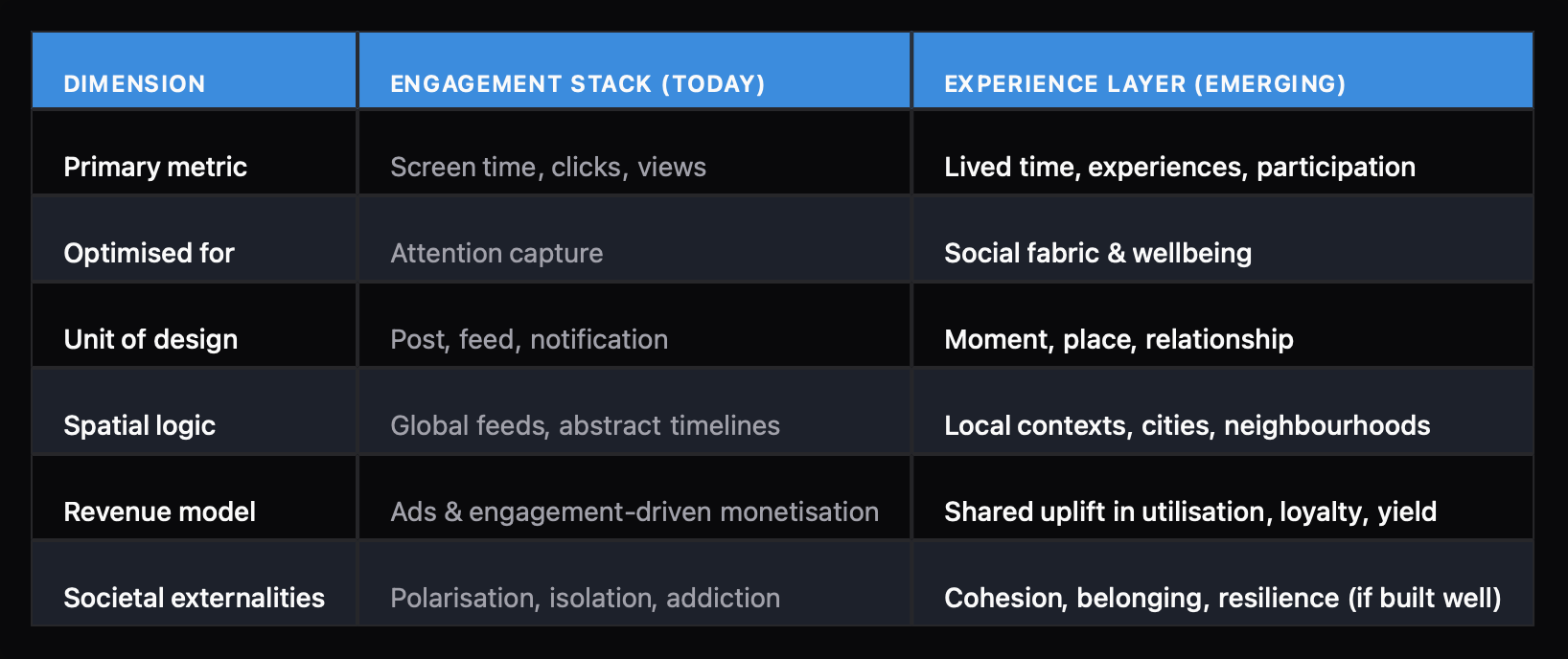
The social outcomes are increasingly explicit. In the EU's first loneliness survey (EU-LS 2022), 13% report feeling lonely most or all of the time in the prior four weeks, and 35% report being lonely at least some of the time. EU Science Hub Older work from the JRC also highlighted the scale of weak ties: 75+ million adults meet family or friends at most once a month, and around 30 million frequently feel lonely.
For younger cohorts, the signal is sharper. A 2024 Bertelsmann Stiftung comparison across Europe reports 57% of young people (18–35) experiencing moderate or severe loneliness. Bertelsmann Stiftung
Europe's paradox becomes clear:
- Europe is structurally rich in cities, culture, third places, and public life.
- Yet social participation is increasingly uneven, and loneliness is rising in cohorts that will shape Europe's next decades. EU Science Hub
- And the dominant digital systems remain tuned to screen engagement, not shared life.
Deriss's contention is that the next phase of European innovation should be judged not only by productivity and growth metrics, but by whether it measurably strengthens participation, connection, and belonging in everyday urban life.
2) Europe's Distinct Position: Industry 5.0 and Human-Centric AI
2.1 Industry 5.0: from shareholder value to social value
The European Commission's articulation of Industry 5.0 explicitly positions research and innovation as drivers of a sustainable, human-centric, and resilient European industry—shifting emphasis from shareholder primacy toward broader stakeholder outcomes. Research and innovation
This is not branding. It is a strategic bet: Europe differentiates by embedding social and ecological constraints into the innovation model itself—rather than treating them as downstream regulation.
2.2 The EU AI Act: human-centric technology as an operating constraint
The EU AI Act reinforces a "trustworthy AI" trajectory. It frames the regulation's purpose as promoting uptake of human-centric and trustworthy AI while protecting health, safety, fundamental rights, democracy, the rule of law, and environmental protection. Artificial Intelligence Act
Together, Industry 5.0 and the AI Act establish a civilisational posture: AI should serve people and society. The missing piece is a concrete translation layer—from policy principles to the texture of daily life in Europe's cities.
Deriss argues that this translation layer is what Europe has not yet named clearly enough—so it is not being built coherently enough.
3) Defining Europe's Human-Centric Experience Layer
3.1 From "coordinating experiences" to civilisational infrastructure
At a tactical level, this opportunity is often described as "coordinating real-world experiences." That phrasing is directionally correct—and strategically insufficient.
Civilisations are defined by the patterns of shared life they enable: the café, the square, the festival, the neighbourhood club, the workplace community, the third place. In a digital age, the systems shaping those patterns are increasingly software-mediated.
Europe's Human-Centric Experience Layer (as Deriss defines it) is:
> A new layer of human-centric infrastructure that uses AI, data, and design to strengthen Europe's social fabric—by helping people access the right experiences, relationships, and places in the physical world, in ways that respect privacy, identity, and planetary limits.
This layer does not replace platforms or cities. It sits between personal lives, institutions, and markets as connective tissue—making participation easier, safer, and more intelligible.
3.2 The Experience Layer Stack: infra, orchestration, surfaces
Deriss frames the stack in three layers:
!The Experience Layer Stack showing three layers: Infrastructure, Orchestration, and Surfaces
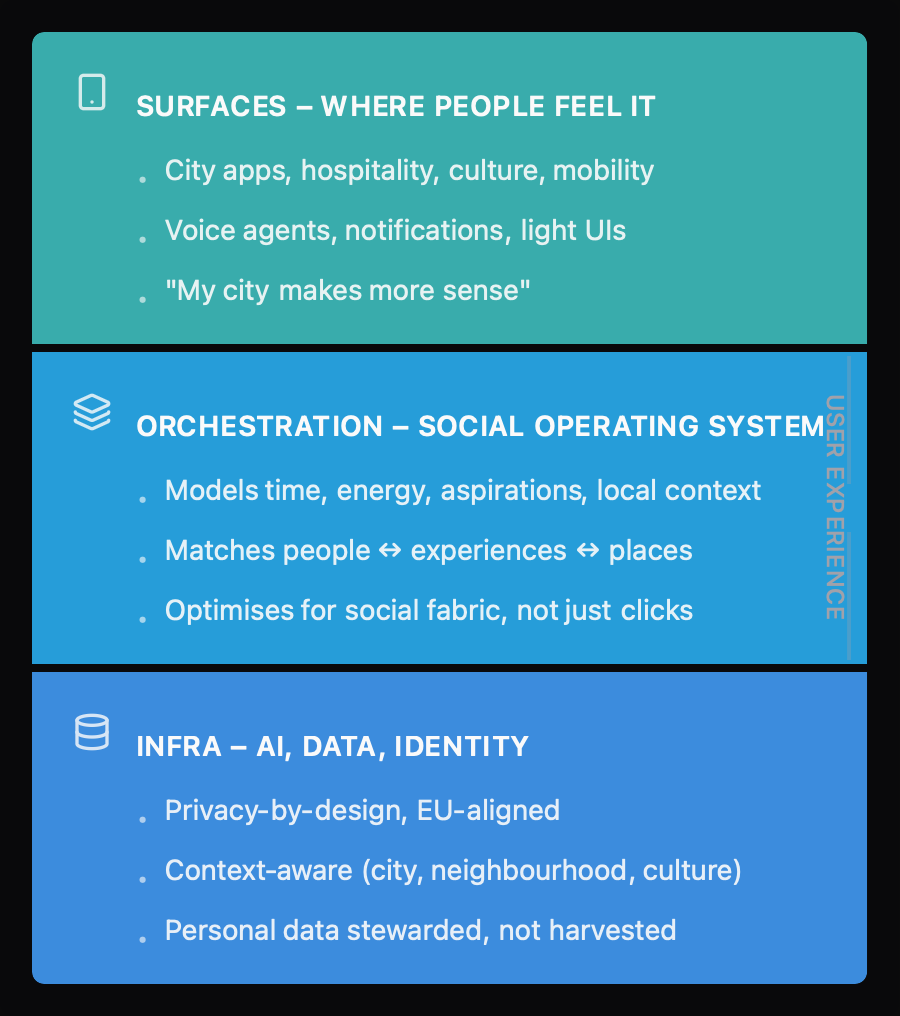
A) Infra — identity, data, and model foundations
The infra layer includes models, context graphs, identity rails, and privacy architecture. In Europe, this foundation must be compatible with rights-preserving governance, not surveillance economics.
A plausible technical direction is privacy-preserving, decentralised, or federated architectures—where useful signals can be derived without centralising sensitive personal data. European privacy regulators have explicitly discussed federated learning as a privacy-enhancing approach (with practical caveats). European Data Protection Supervisor
B) Orchestration — the "social operating system"
Orchestration is where the Experience Layer becomes civilisational. It behaves less like "events discovery" and more like an agentic portfolio manager for time, energy, and social capital.
It maintains dynamic models of:
- a person's constraints (time, money, mobility, energy, safety),
- their aspirations (belonging, learning, wellbeing, contribution),
- and city context (what's happening, where friction exists, what's accessible).
It then proposes sequences of experiences that help people build real-world belonging—without coercion, addiction loops, or privacy collapse.
This is where Industry 5.0 becomes tangible: technology as partner in human development and social resilience, not as extraction machinery. Research and innovation
**C) Surfaces — where people feel the difference**
Surfaces are the touchpoints where citizens encounter the layer:
- city apps and civic services,
- cultural/hospitality/mobility integrations,
- voice-first agents that support routines and transitions,
- community operators and "third places" that become easier to access.
Most people won't care what stack they're using. They will care that their city feels more navigable—and that it becomes easier to find "my people" and "my places" without surrendering autonomy.
4) Value Creation: Economics of the Social Fabric
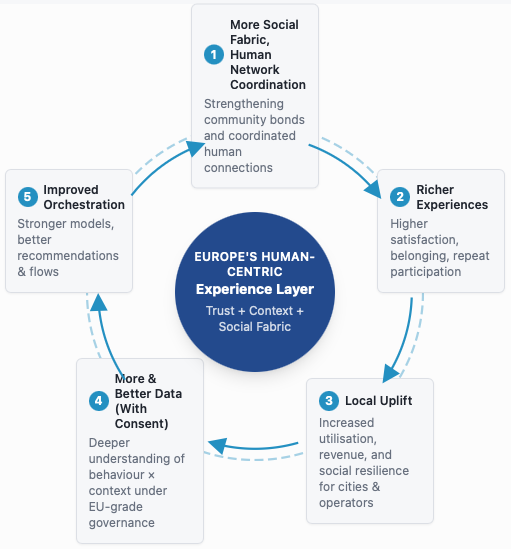
A human-centric Experience Layer is not only a civic project. It is an economic one—because it increases participation, utilisation, and repeat engagement across the physical economy.
A useful anchor is the cultural and creative economy. The European Investment Fund's market study (covering EU-27 plus Norway and Iceland) reports Cultural and Creative Sectors (CCS) value added rising from ~€264bn (2013) to ~€354bn (2020), with Audio-Visual & Multimedia alone representing a large share of value added. EIF
The Experience Layer amplifies value across three points in the stack:
4.1 Infra providers
Monetisation logic: EU-aligned data infrastructure, privacy tech, contextual intelligence, interoperable identity.
Defensibility: trust, governance, integration depth, and compliance-ready design.
4.2 Orchestration platforms
Monetisation logic: participation fees, subscription, licensing to cities/operators, uplift-based revenue share (conversion, retention, utilisation).
Defensibility: capability to tune systems to local contexts; governance reputation; cross-partner integrations; high-quality behavioural feedback loops held under strict stewardship.
4.3 Surface operators (cities, hospitality, culture, mobility, third places)
Value realised as:
- higher utilisation of under-used capacity,
- better matching (higher satisfaction, higher repeat),
- new formats (micro-gatherings, neighbourhood circuits, cross-venue programming),
- measurable public benefits (health, cohesion, resilience).
Critically, this is unlikely to be winner-takes-all in the classic platform sense. The Experience Layer's logic is plural and local: cities differ; cultures differ; governance differs. The durable opportunity is to build interoperable infrastructure and repeatable playbooks—not to "own all experiences."
!The value accrual flywheel reinforcing the Experience Layer
5) Why Stockholm and Scandinavia are unusually good proving grounds
The Experience Layer thesis becomes concrete in Scandinavia because the region has (1) high digital readiness, (2) strong institutions, and (3) an increasingly explicit mandate to treat loneliness and participation as public priorities.
Sweden's Public Health Agency published Standing together (2025): a national strategy to tackle loneliness (applicable 2025–2029) and explicitly frames loneliness as both a societal and public health problem, requiring coordinated action across government, regions, municipalities, civil society, business, academia, and individuals. folkhalsomyndigheten.se
The document also provides Swedish prevalence indicators (e.g., adults "often or always" troubled by loneliness; youth loneliness; and related social support measures).
On the research side, Stockholm University's public health work highlights social connectedness as a crucial factor in youth mental health, especially across adolescence and young adulthood—life stages characterised by major social transitions. Stockholm University
Finally, Scandinavia's household structure matters. Both Swedish statistics and Eurostat reporting underscore high shares of single-person households, which changes the baseline conditions for everyday connection. European Commission
Put together: Stockholm is a credible laboratory for building "soft infrastructure"—systems that increase participation and belonging while staying aligned with European values and governance.
6) Strategic Implications for European Leaders
6.1 For founders and technology companies
The strategic shift is from building another engagement product to building components of experience infrastructure:
- Build behind the interface: infra and orchestration can be more durable than a single consumer surface.
- Design for European constraints as a feature: privacy-preserving architectures and trustworthy governance become product advantages, not friction. European Data Protection Supervisor
- Choose a wedge: one city + one vertical + one persona, then expand via interoperable integrations rather than generic scale fantasies.
Success metrics must evolve beyond "time spent" into measurable participation outcomes: repeat attendance, retention of community members, wellbeing proxies, diversity of ties, and reduced barriers to access.
6.2 For operators: hospitality, culture, mobility, retail, third places
Operators should treat the Experience Layer as demand quality infrastructure, not merely marketing:
- Activate off-peak capacity through curated programming.
- Improve matching (better-fit audiences → better reviews → higher repeat).
- Co-create circuits and rituals (weekly, seasonal, neighbourhood-anchored).
6.3 For cities and institutions
Cities can treat the Experience Layer as soft infrastructure that complements transport, housing, and services:
- Create procurement paths and sandboxes for human-centric pilots.
- Define non-negotiables: privacy, safety, inclusion, transparency.
- Keep key capabilities interoperable and auditable, avoiding lock-in.
6.4 For investors
The investment lens shifts from "MAU growth" to:
- regulatory alignment and governance maturity,
- depth of city/operator partnerships,
- evidence of sustained behaviour change in the real world.
7) Conclusion: a civilisational bet
Every era chooses what it will optimise for. The early 21st century optimised for attention. Europe is now articulating a different trajectory—human-centric, resilient, values-aligned innovation. Research and innovation
The Experience Layer is Deriss's name for the missing infrastructure that makes this real in daily life—helping people participate in cities, form durable ties, and access culture and community without surrendering autonomy.
The open question is not whether an Experience Layer will emerge—but who shapes it, where value accrues, and which values get encoded into its technical and institutional design.
References
- European Commission — Industry 5.0 framing and stakeholder shift. Research and innovation
- JRC — EU Loneliness Survey 2022 and related policy briefs. EU Science Hub
- Bertelsmann Stiftung — youth loneliness comparison in Europe (2024). Bertelsmann Stiftung
- Public Health Agency of Sweden — Standing together national loneliness strategy (2025–2029). folkhalsomyndigheten.se
- Stockholm University — social connectedness and youth mental health. Stockholm University
- European Investment Fund — CCS market study and value-added figures. EIF
- EDPS TechDispatch — federated learning as a privacy-enhancing approach (with caveats). European Data Protection Supervisor
- Eurostat + SCB — household structure context. statistikdatabasen.scb.se